

Our home should be more than just a shelter. It should be a place where we can rest, feel safe, and stay comfortably with our loved ones. Yet many of us live in homes that feel cold in winter and are expensive to run. In 2024, an estimated 2.73 million households in England were in fuel poverty, suggesting that around 1 in 10 families struggle to heat their homes and stay warm.
Whether you have a draughty home or you are considering making your home warmer, you may want to know more about EnerPHit Retrofit. While this term may sound technical, it’s the gold standard for transforming an existing house into an energy-efficient, healthy, and comfortable home. We are experts in this area, having completed the second domestic EnerPHit retrofit in the UK.
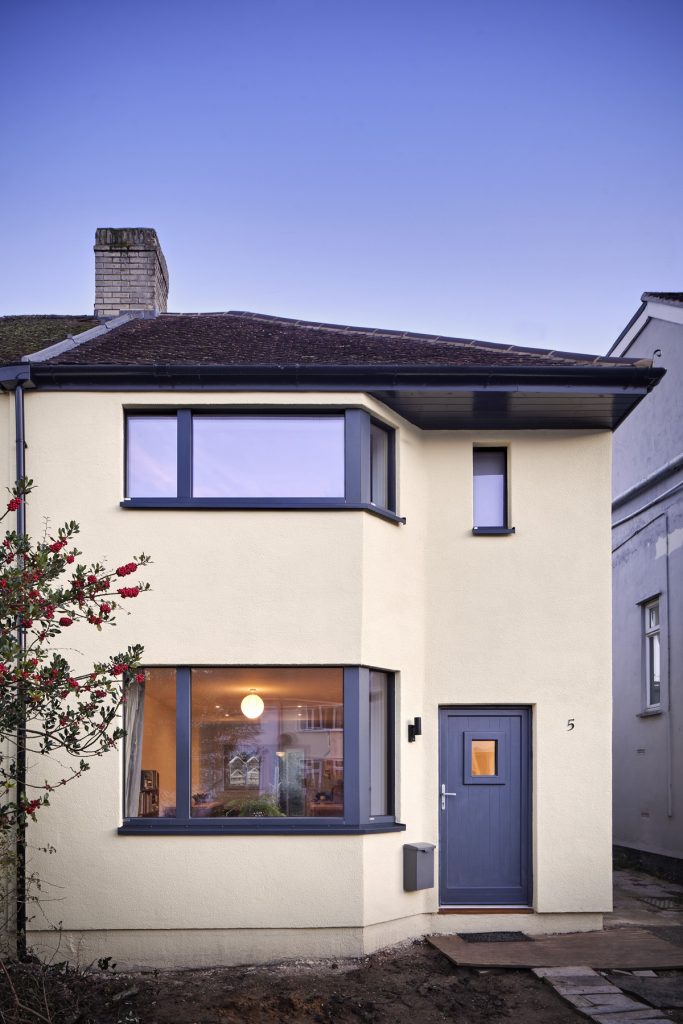
What exactly is EnerPHit Retrofit?
To understand EnerPHit, you first need to know about Passivhaus. Passivhaus, or Passive House, is a proven standard for building design. It aims to create buildings that require very little energy for heating or cooling, while still keeping occupants comfortable.
This standard is growing in popularity across the UK. In 2023, the Scottish Government announced plans to create environmental design standards for new houses, similar to the Passivhaus standard. The Welsh Government also consulted on the Building Regulations, proposing a new air permeability standard equivalent to the Passivhaus standard. New UK policies coming in 2026, such as the Future Homes Standard and the London Plan, are likely to reference the Passivhaus standard, broadening its influence.
EnerPHit is the version of this standard specifically created for existing buildings. It acknowledges the challenges of retrofitting buildings to improve energy efficiency and sets a realistic yet challenging goal. This often leads to a building that performs better than a new one in terms of energy use and comfort. Research from the Passive House Trust shows that a typical new build has an annual space heating demand of about 85 kWh/m2. In contrast, an EnerPHit building requires less than 25 kWh/m2. This means you will barely need to turn on your heating throughout the year.
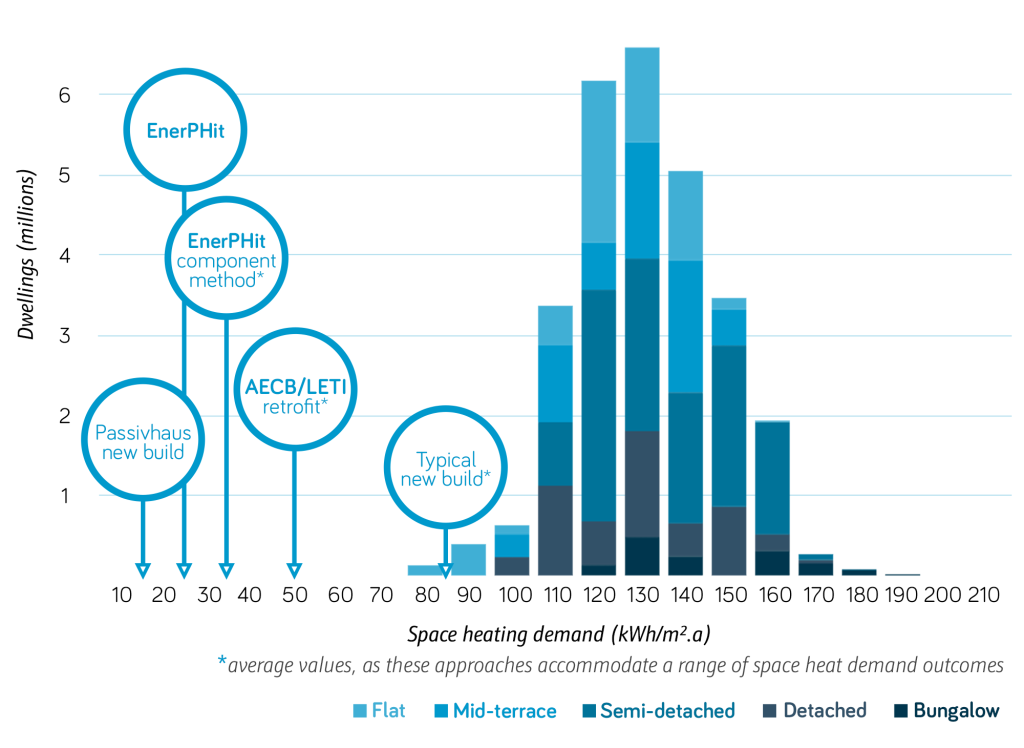
source: Passive House Trust
Why bother with EnerPHit for your home?
Apart from the extremely low energy demand, here are some of the many benefits of an EnerPHit home:
- Exceptional Comfort: Your home stays at a consistent, comfortable temperature of around 20 degrees, even during the coldest winter days.
- Better Health: Your home is air-tight and well-ventilated, with no cold spots. This means good air quality and no more mould or condensation in the house.
- Quality Assurance: Your home is certified with clear, measured metrics. This process ensures careful construction and strong durability, helping your home last longer.
- Lower Bills: Your home is more affordable to run because it uses less fuel to stay warm. A ‘fabric-first’ approach makes your home resilient to extreme weather.
- Climate Emergency: By being energy-efficient, your home helps address the climate emergency and reduces strain on the electricity grid as we decarbonise heating systems.
How you can get an EnerPHit home—Why Professionals Matter
EnerPHit is great, but the question is: how?
It’s tempting to think of retrofitting as simply adding insulation and installing an efficient heating system. However, if not done correctly, it can be more harmful than doing nothing at all. Not long ago, I read about a family whose Christmas was ruined by widespread black mould caused by improper internal wall insulation. Shallow retrofitting often overlooks important factors such as moisture management, which can lead to unintended consequences, including condensation and structural damage.
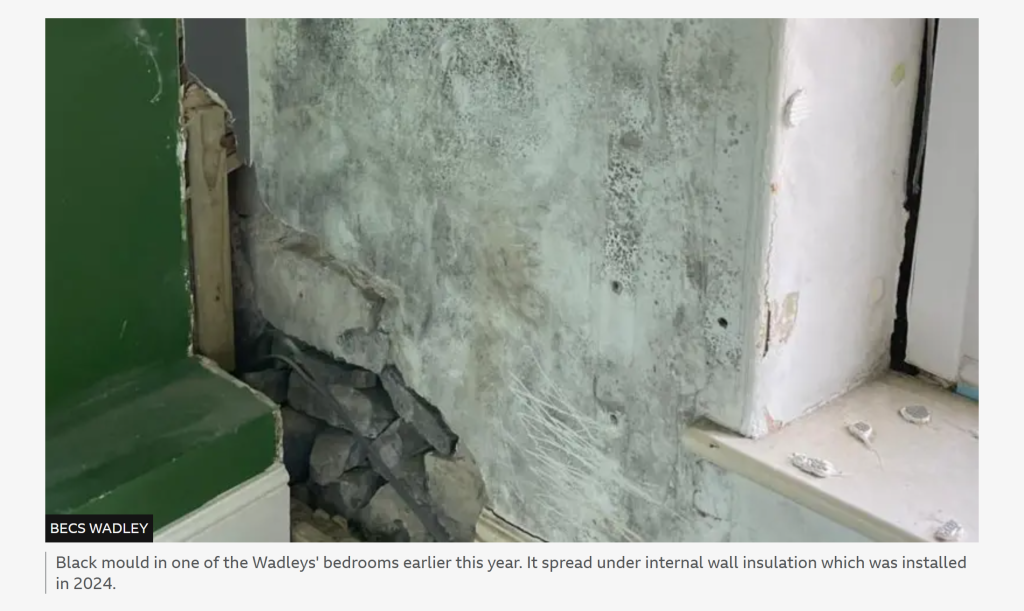
source: BBC News
To achieve EnerPHit, you need a comprehensive approach, not just shallow upgrades. It’s important to involve professionals early in the planning process. This helps ensure that all measures work together well, that you choose the right materials, and that you manage moisture without harming the existing fabric. A certified Passivhaus designer or consultant will use a design tool called the Passive House Planning Package (PHPP). PHPP looks at various factors affecting heat loss, energy use, and internal comfort. It helps to match expected energy use with real-world performance, reducing the risk of unexpected problems.
How we can help
If you’re unsure about how to begin or if you are planning to improve your home, our team of experienced Passivhaus designers and architects is here to guide you through the process. We offer a free 30-minute consultation to discuss your project, needs, and budget, and to explore how we can collaborate effectively. Following the conversation, we’ll provide you with a document detailing our approach, which will include a schedule of services and a fee proposal. Improving your home to the Enerphit standard can be costly, but you can make it more cost-effective by doing the work in phases, which provides greater financial flexibility.
Our services range from a whole house retrofit plan—a roadmap outlining how retrofit and extension measures work together, including costs and impacts on energy use and comfort—to construction drawings and specifications. This way, you can ensure that every change you make today contributes to a better future, avoiding wasted efforts and potential risks.
Ready to start?
To understand how we work, please explore our service page, or get in touch if you have any questions (admin@transitionbydesign.org).
Further Reading
- Our EnerPHit project in Oxford – Hutchcomb Road Oxford: Setting the standard for climate positive retrofits
- UK’s Passivhaus organisation’s introduction video – Passivhaus Goes Personal
- 21 Degrees’ article about Enerphit – Refurbishing your home using the Passivhaus approach
- More on EnerPHit standard- EnerPHit: The Passive House Standard for retrofits